On a recent sailing adventure I found a real treasure to add to the boat names collection. Sighberspace. What a terrible boat name. Imagine with me for a moment Sighberspace’s distress call; “Mayday mayday, this is Sighberspace.” It’s such a bad joke name for a boat, not to mention just a downright terrible computer joke that can only spark more terrible computer jokes. If I wanted to relax, you’d better believe I’d spend some time floating around in Sighberspace. Har har.
August 24, 2008
Collections for Personal Enrichment
On a recent sailing adventure I found a real treasure to add to the boat names collection. Sighberspace. What a terrible boat name. Imagine with me for a moment Sighberspace’s distress call; “Mayday mayday, this is Sighberspace.” It’s such a bad joke name for a boat, not to mention just a downright terrible computer joke that can only spark more terrible computer jokes. If I wanted to relax, you’d better believe I’d spend some time floating around in Sighberspace. Har har.
August 18, 2008
Millennial Mania
I realized recently that the youngest of today's library school students are among the first crop of millennial librarians. In this vein, I have a confession to make. I am a millennial (a fact that I hadn't confronted about myself until, fittingly, I read it in black and white on Wikipedia). So what does it mean that we new librarians are in the same generation as the students that more experienced librarians are desperately seeking to understand?
As a millennial (however reluctant I am to admit it because it makes me feel like an awkward middle schooler), I am accustomed to rapidly-evolving information and communication technologies. I remember dial-up, but barely. I may not be a skilled texter, but I could be if I focused more.
I rarely have the attention span to read a book cover-to-cover, but I can spend hours following a trail of interesting Facebook updates.
I've been asking around about millennials, and I've heard they expect information resources to be intuitive, to be Google or Wikipedia-esque in their ease of use. I've also heard that millennials are as likely to rely on peers as they are to rely on their superiors for "expert" advice. I’m not sure how true these things are of me, but I think they may be generally true of those youngsters born in the 1990s.
This collaborative way of approaching knowledge (and in a sense determining our truths by the consensus of any given moment) signals a shift in society discussed --and sometimes bemoaned-- by philosophers and pundits alike. But older generations have a history of worrying about what cultural dead-ends those young kids are leading us into. And as of yet, cultural evolution has continued apace both despite and because of the innovations of the young.
Personally, I don’t think we need a revolutionary response to millennials’ supposed information, communication and technology prowess. I don't think we need the brand "Library 2.0" to open ourselves to a paradigm shift. Libraries have always evolved to reflect society’s views of knowledge, and have so far managed to remain relevant and useful. Maybe we respond a little more slowly to the latest technology, perhaps with slightly more deliberation. But we adopt the things that work and we empower our patrons adopt them, too. I value this traditional function of libraries as much as the next librarian, millennial or no.
So, what does it really mean to be a millennial librarian? Is there really a generational gap here, or are the reports of our differences greatly exaggerated?
* Beware that Wikipedia link, the year range listed for the "millennial" or "gen y" generation changes regularly. I guess that's a symptom of society's attempt to describe itself as it evolves. Or the lack of authority and dependability of Wikipedia articles. Take your pick. For more on naming the millennial generation, see this Washington Post article.
August 10, 2008
Theft, Part II: TO CATCH A THIEF
James Shinn, who got his 15 minutes of infamy in the early 80s, was caught by a librarian at the Oberlin College Library in 1981. He had stolen 480 rare library books with a combined value of $35,000. Shinn is a nerdy-interesting Google if you are curious. A brief 1981 NY Times article describes the manhunt. Besides inspiring librarians in general to beef up security for special collections, Shinn also gave librarians at Oberlin a hearty sense of their own crime-fighting capabilities, thus enabling me to have my very own brush with library covert ops nearly 25 years later.
The Oberlin College Library has a special room named for James Shinn and plastered with news stories of his crimes and capture. This room is not open to the public and is rarely visited by staff. The Shinn Room is the library’s Executive Washroom. I mean, where better to study a rich history of library heists and library heroism than a library director's bathroom? Nowhere, I suppose.
P.S. Mr. Shinn, if you Google yourself regularly, thanks, and no hard feelings!
August 6, 2008
Summer Time Warp
Patron: (gets up from the computer he is seated at and slowly approaches the librarian) Excuse me, do you know what the date is?
Librarian: (looks up from the computer) Hello. Yes. It is August 5th.
Patron: (confused) I'm sorry did you say August?
Librarian: Yes.
Patron: (squints and shakes his head) It's August?
Librarian: (shows patron a calendar on the computer screen) Yes.
Patron: I missed my flight.
Librarian stares at patron with a commendable straight face. There is a long silence.
Patron: Huh. (pauses) Do you have a pay phone I could use? I think I need to make a phone call.
Librarian: I'm sorry, we don't have a pay phone. There is a pay phone on Liberty near Border's.
Patron hurries out the door. Librarian shrugs and goes back to looking up interesting things on the internet.
August 4, 2008
Theft, Part I: LIBRARY STAKEOUT
In my undergrad years, I worked as a circulation desk attendant and student supervisor at the Oberlin College Library. One year, we had a rash of laptop and backpack thefts. No matter how many signs we posted warning people of the danger, they still left their stuff unattended and it still got stolen. One patron came to the desk in tears to report not one, not two, but three separate thefts of her valuables over the course of a week. (Responses among library staffers ranged from sympathy to incredulity that she would leave her stuff unattended the second two times.)The library administration decided reporting these numerous incidents to Safety and Security after the fact was not enough. We needed to catch a thief red-handed. Thus, a plan was hatched and a LIBRARY STAKEOUT was born.
Late in the semester, the library's student workers received an email announcing extra work shifts. We were told we had the chance to join the library's effort to end the theft problem once and for all (well... at least for that school year). Get paid for a covert mission in the library? Yes, please! The following day, I signed up for my very own stakeout.
This is how it went down: A circulation staffer planted a "dummy" backpack in a high-traffic area of the library.
Whoever was on stakeout duty got paid to sit in a darkened room for an hour with a walkie-talkie and keep a watchful eye on our planted backpack. If we saw someone grab the bag, we were to radio down to library administration, where the library director or assistant director would run out of his office and stop the thief as he or she exited the building. The staff implemented this plan with fervor (that particular and rare fervor of bored library workers who are suddenly tasked with a vitally important stakeout mission).Photo: abbyladybug on Flickr - pretty much exactly where our backpack was planted.
You're probably buzzing with excitement right now, just as we were in those precious, early days of Operation Catch-A-Thief.... Come on, already! Did you catch the thief or what?
Day in and day out, we watched that dummy backpack. Day in and day out, we brought the backpack back to the staff area at the end of the day's scheduled stakeout shifts, simultaneously relieved and disappointed that no theft of our utterly conspicuous fake bag had been attempted.Soon, since no more thefts had occurred, the stakeout shifts became more expensive than they were worth. How could it have been that we had so many thefts, followed by none at all, right as we began our stakeouts?
I have a theory. Remember that email I told you about, in which all the student workers of the library system were offered extra hours? And remember how hilarious and ridiculous it seemed that the library would pay us to sit in a darkened room watching a planted backpack, armed with only a walkie-talkie, intense focus and the library director as backup? I forgot to add that there was a clarifying email sent out a couple of days after the first, reminding us that this library stakeout mission was supposed to be... a secret.
But if all those other library workers were anything like me, they got that first email and immediately told everyone they saw that day about an amazing new project at the library. And like me, when they got that second email, they probably thought, "Oh, well... you probably should have told us that to begin with."
Instead of catching our thief red-handed, the Oberlin College Library effectively spread the word that the building was being closely monitored by staff. Instead of stopping crimes in progress, we successfully prevented them.
Come to think of it, all the library had to do was convince its student workers that a series of stakeouts would occur, and we took care of the rest. I guess it just goes to show: you should never, ever underestimate the power of a funny story.Photo: StudentsReview - Oberlin's Mudd Library. Looks like a fortress, but it wasn't really. Until the stakeout.
July 30, 2008
The Typical Librarian (a Friendless Old Hag?)
This satirical commentary on our current political climate, where debate continues as to whether the use of torture will strengthen our national security, compares steep overdue fines meted out by librarians to the cruelest form of physical punishment.
Since we librarians generally have a sense of humor, I'm not going to argue with this representation.
July 27, 2008
METADATER: a long explanation for a short joke
So, feel free to skip ahead if you already know a thing or two about metadata. Or don't, if you want to see me try to explain it.
Context: What the heck is metadata, anyway? According to wikipedia and SI, metadata is "data about data." Metadata helps us make sense of information by providing us with context. It allows us to better communicate and organize information and thus retrieve information more efficiently.
Titles and formatting are examples of metadata often used to describe text. For instance, the metadata I apply to READ THIS NOW! tells you a lot more than a less invasive "read this now" would have. The metadata (bold, caps and exclamation point) I use to describe the data (three words which represent your imperative) helps me communicate my meaning, draws your attention and hopefully inspires you to continue reading. It also allows me to classify what I say as important, rather than just plain old words like the stuff around it.
Recently, when I asked a fellow information professional if he had any thoughts on metadata, he asked, "Can you be more specific?" I said no. He said, "It's a ... good thing?" Metadata. It's a good thing. http://en.wikipedia.org/wiki/Metadata
Aaaaanyway...
What's the deal with METADATER? Last semester, I was writing a literature review on Metadata Standards and Interoperability for the Digital Libraries course that Emily and I took together. While this may sound vaguely impressive, I can assure you that I had almost no idea what I was talking about, but I sort of guessed at a string of plausible words and ended up sounding mildly coherent. Professor, if you're reading this... sorry dude. Thanks for the passing grade.
So Emily and I were both typing like mad in the office trying to get these overly technical lit reviews done and submitted on time, and I typoed "metadater" and I sort of cackled and said "METADATER!" in this incredibly nerdy affected voice and we both died a little in a good way. We wrote the term on the office white board and it lasted for a while.
Since then, we've realized what METADATER is really all about. We've learned the true reason I discovered the concept in the first place.
METADATER is an online dating site for information professionals. Or it should be. It doesn't actually exist. But it could.
After all, http://metadater.com/ was recently "registered\purchased." And who knows what it'll be when it finally goes live.
I'll give you a few moments to think about the ramifications.
Seriously?
Yes.
Need a good LOL read?

I'm going to get really agitated if one more person remarks to me, "Do you really have to go to graduate school to be a librarian? I just thought you needed to know the Dewey Decimal System...hmmm...." (The best response I've ever gotten to the "what are you doing with your life?" question was, cracking up laughing, "no really, what do you want to do when you are done with college?") Though I think that graduate level education is appropriate for librarians, I think that most of the things that we encounter in libraries are experiences that our Web 2.0 education cannot fully prepare us for.
Scott Douglas' Quiet, Please is memoir of his experience as a public librarian. Douglas humorously describes the current issues in libraries, and the experiences that library school doesn't prepare us for. Basically, the book is a collection of humorous accounts of grumpy-pants co-workers, the importance of community, issues surrounding Myspace and porn in the library, food in the library, and my favorite, problem patrons. No one can resist a good problem patron story. Librarians live for them. They spice up our days.
Douglas' memoir is a fun read that I think all information professionals can relate to in one way or another. Let's be honest, it's a total jungle out there in Library Land, and you probably need some summer reading that will remind you that you can survive it. Read on and on.
July 16, 2008
Extraterrestrial Life: A Quick Lit Review
Dartnell, L. (2008). Hairy Blobs found in an acidic hell. New Scientist, 198(2569), 15.
- This article addresses recent research that shows life (in this case, hairy blobs) could survive in similar conditions to the Martian oceans (an acidic hell).

Pendick, D. (2008). Earth through alien eyes. Astronomy, 36(5), 23.
- This article discusses whether aliens with our current level of technology would be able to find Earth from lightyears away. The answer is yes, they could.
- My favorite quote is from scientist Sara Seager, who discusses her research published recently in The Astrophysical Journal: "Maybe somebody's looking at us right now, finding out . . . the length of our day."
- Quite possibly, aliens are discovering the length of Earth's days as I write this blog entry. What an extraordinary thought!
- This newspaper article was originally published in The Morning Call of Allentown, Pa. I've never heard of this paper, but now I wish I read it every day.
- In an interview in the Vatican newspaper L'Osservatore Romano, Rev. Jose Gabriel Funes (the Vatican's top astronomer, according to the article) says rejecting the the idea of alien life outright would be "putting limits on God's creative freedom." Extraterrestrial life is apparently a "thorny" theological issue in Christianity, but the Vatican has made its position clear.
- In addition to Vatican experts, this article includes views on the topic from a UFO researcher:
Besides, he added, aliens themselves may be creatures of faith. In a few of the many thousands of reports of alien abduction, abductees said they could speak with their captors. "Where people could ask questions, one of the questions they asked was, 'Is there a God?' or 'Do you believe in God?' " Bassett said. "Without fail, the ETs would say 'Yes.' "
July 11, 2008
Emily and Katie's Super Classy Office Warming Reception!
July 7, 2008
Why I am becoming a librarian
What are your nerdy motivations for your profession? Dear reader, assure me I am not the only nerd out there.
July 3, 2008
LIBRARY ORIENTATION: the coolest gig in town
Let us set the scene...
THE PEOPLE - overwhelmed and/or cocky 17 and 18 year olds, 50-ish per session, in groups of 6-10 per table.
THE ACTIVITY - a worksheet, the students try to figure out the themes of their tables (not that hard), say what the stuff can be used for, then present their findings to the entire session.
THE SPACE - the Grad Gallery, decked out in the finest signs and banners.
US - Emily H, who hates hamsters; Katie D-T, who has enjoyed Delerium Tremens (a belgian brew) but never had the DTs.
OUR LOVELY ASSISTANTS - one rotating UGLi Babe (that's a librarian, to the uninitiated).
Now that we have laid our stage, please allow us to entertain you with a story or three...
1. One of our fellow librarians, Renoir, has an excellent presentation style. Not unlike an improvisational jazz musician, Renoir riffs on the things the students say (i.e. he uses the openings the youngsters provide to regale us all with stories of the library which swell and reach new heights and show off his oratorial prowess).
Our favorite Renoir story came up in multiple orientation sessions. One day, a student asked, "Is there a limit to the number of books we can check out?" Smiling slightly, Renoir responded "I'm glad you asked," and proceeded seemlessly into this wonderful story.
Several years back, some student groups banded together to protest against another club. They were nerdy and creative and they decided to center their direct action on the library system. On one fateful day, these students rented U-Haul trucks and parked them outside the library. They brought armful after armful after book truck of library books to the circulation desk, hoping to stun the library -- and the university -- in its tracks. The students were successful. Every library staffer had to stop what they were doing and spend their entire day checking out books and loading books into U-Hauls. The librarians complained to their supervisors, and the complaints made their way up to University Administration. The student groups, through a clever knowledge of library policies, eventually emerged victorious.
2. One of our more adolescent incoming students shared with some 70-odd entering Wolverines a picture of a penis he and his tablemates found in a graphic novel. Emily, noticing that each novel at the table was open to its most explicit content, made a quick recovery, acknowledging the penis and addressing the major Graphic Novels Table talking points, thus saving orientation.
3. Katie ended a solid session with a solid quote by pop princess Shakira. The musical theater students she was orientating were impressed, and began to sing the song. Quote: "So, librarians are available whenever, wherever ... we're meant to be together.... yeah, I just ended with a Shakira quote."
June 25, 2008
Legalize it (Books)
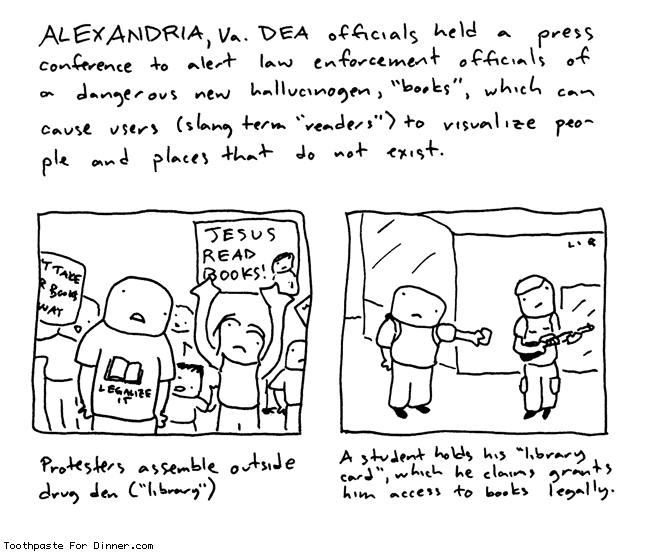
ALEXANDRIA, Va. DEA officials held a press conference to alert law enforcement officials of a dangerous new hallucinogen, "books", which can cause users (slang term "readers") to visualize people and places that do not exist.
- Protesters assemble outside drug den ("library")
- A student holds his "library card", which he claims grants him access to books legally.
I'm so glad that in the real world, books are available over-the-counter without a prescription or legal repercussions. Well, if you don't count copyright law.
June 22, 2008
These children shall pass fifth grade

During the war Winston Churchill He became Prime minster. He was for England. At that time His grandFather deid. When the war ended Winston ChurchiLL sadly deid. I January 30, 1965. In Oxford england. they threw him in the river.
I made sure to buy some biographies for the library.
June 18, 2008
A blast from the past
June 16, 2008
It’s Already Been Broughten, or the story of one librarian’s journey to the 1st Annual Bilderberg Challenge
------------------------------------------------------
[BRING IT] softball -- archivists vs librarians (BRING IT)
For literally hundreds of millions of years, tension has been brewing between archivists and librarians...
Well stop your shushing, put down your acid free folders, and get ready because forever is about to be decided:
THE 1ST ANNUAL BILDERBERG SOFTBALL CHALLENGE
When: Saturday, June 7, 2008, 1 pm
Where: Burns Park Softball Diamonds (look it up or follow the information scent)
Who: Archivists vs. Librarians
What: A duel on the diamond - standard softball rules - bragging rights at stake - in a word, BRING IT!
------------------------------------------------------
This email, issued by Maureen and Bill, ARCHIVISTS AT LARGE, started a revolution in the SI community. No longer was the listserv dominated by a handful of HCI enthusiasts. It was time for the traditional information professionals to take the stage, and take it we did, rocking the status quo.
This challenge marked my entrée into the world of SI-all email communications and sparked a fever in my heart that could only be cured by MORE SOFTBALL.
On 06/07/08 at approximately 1:23 pm, the 1st Annual Bilderberg Challenge began, a softball showdown between archivists and librarians. The archivists, hosts and home team, were decked out in black. The librarians wore white. There was tension in the air and a storm was brewing. Everyone in attendance recognized an epic battle was underway.
As a proponent of librarianship and former captain of the Oberlin varsity softball team, I knew it was my duty to unite LIS students and allies to overcome ARM’s attempts to undermine us. We dominated from the moment we stepped on the field; the Bilderberg Trophy was at stake and we could taste victory with every pitch.
With our reputation on the line, we put the archivists’ trash talking to the test, and they crumbled under the weight of our heavy bats and profound fielding prowess.
Librarians 16, Archivists 7.
May 30, 2008
Planning a scavenger hunt/tour
I've been scratching my head to come up with ideas for a tour that will be engaging and will help students learn about the library without the activity feeling like a chore. I think I've settled on creating a scavenger hunt, in which students follow clues that lead them to different parts of the library. I think something active will be more well-received and ultimately more useful for students, but I have yet to figure out exactly how to implement this idea.
So far I have a list of places I want to be stops on the tour/hunt. I'm trying to think of a theme, and decide what the clues will be. Some ideas we've come up with so far: crossword puzzles, word finds and photos of the next location. Originally, this tour was going to just be a Flickr photoset of the library, but I think the scavenger hunt has much more potential to actually be fun and interesting for incoming students.
Has anyone ever planned and created a scavenger hunt or active tour before? Got any suggestions? Send them my way.
May 21, 2008
He doesn't even know I exist (insert sigh here)

I was spending some time in the British Literature section (PR's for library nerds) of the UGLi the other day, deciding what books we should keep and what we should get rid of. I stood a minute pondering on whether or not we needed two copies of Oroonoko by Alphra Behn, when this lovely photo fell out of the book. I always knew I'd meet my true love in a book, I just didn't expect him to be so good at wheelies.
May 19, 2008
The Big Move
The old office, being moved:
Despite our worries, the new office seems quite homey. What a relief!
The new office:
We are now housed on the second floor of the UGLi. And we have a FLASHLIGHTS drawer.
April 17, 2008
What you can really do with a library degree
Katie and I were in the office today avoiding writing our papers for Digital Libraries. Katie was paging through a book we recently found in the office titled What Else You can do with a Library Degree: Career Options for the 90s and Beyond. The book inspired her to perhaps switch her specialization to tailored and take classes that would enable her to become a private investigator. I was in sort of a tizzy and was feeling very uninspired, until Katie said, looking up from the book and at the computer screen at the introduction to her paper, "I wonder how many words I have already." My response, "200." Katie hit word count, "200!" The next edition of What Else You can do with a Library Degree: Career Options for the Internet Age will most likely list psychic.
I guess that librarians do need to be a bit psychic though. How else could we find the right source with so little to go on? (true example; student: "I have to write a paper about my passion." librarian: "what's your passion?" student: "War"... moments later the search/ student's passion is defined as American opposition to the Korean War).
April 15, 2008
TAX DAY! or, how this one time, I almost didn't graduate from Oberlin but then I shaved a rat's head and everything magically worked out for the best
In past years, April 15 would find me scrambling to complete my overly complicated, multi-state, last-minute tax reporting. Somehow, this year, I got my taxes done early and mailed YESTERDAY. I am like, so administratively sound right now, you guys.
In other words, I shaved the rat's head. This did not go incredibly smoothly, since Orpheus wasn't quite anesthetized enough, and was pretty squirmy. Nevertheless, I completed the task and then rushed off to my softball game. I remembered to go to the rest of the classes, and eventually passed the lab with flying colors.
In the end, I graduated. On time. All thanks to Orpheus, who (begrudgingly) let me shave his little rat head when my academic career needed it the most.
March 30, 2008
Poetry Break
... I punched
out Garbage at the library and four titles
swept the screen, only one, Garbage Feed,
seemed worth going on to; and that was about
feeding swine right: so I punched Garbage Disposal
and the screen came blank--nothing! all those
titles, row on row, of western goodies, mostly
worse than junk, but not a word on Disposal: I
should have looked, I suppose, under Waste Disposal
but, who cares, I already got the point: I
know garbage is being "disposed" of--but what
I wanted I had gotten, a clear space and pure
freedom to dump whatever, and this means most
of the catalog must go, so much that what is
left will need no computer to be kept track of:
har:...
March 24, 2008
UGLi Field Trip

On Friday the staff of the UGLi piled in maize and blue mini vans and traveled to the new Border's. I'm directionally challenged so I couldn't tell you where it is, but it is in Ann Arbor somewhere. Anyway, the store is a test case for their new "concept stores." Basically, the store is just a really big, really technologically advanced bookstore with lots of flashy stuff.
From the moment I walked in, I felt like I was in a computer store, and got overwhelmed. The store manager who gave us a tour must have read my mind when he said, "this space used to be a CompUSA." The store did have some neat shelving and seating, and some clever organizational ideas. But, the big screen t.v.s on the walls made me feel like I was in Best Buy. The store has a technology area that includes a space where customers can make their own CD mixes and download e-books. The thing that really got me was "the Long Pen," which is this teleconferencing device where you can meet an author and they can sign your book. You can see the author over the screen, they can see you, and then you put your book under the machine and the author signs their name on their thinkpad. The "Long Pen" then signs your book, stroke for stroke. It was weird. I have wonderfully awkward memories of meeting authors and basically tripping over myself (not to brag but I ran into David Sedaris in Paris and it was visibly shocking for me). It's refreshingly human to not be able to just turn off a camera and hide sometimes. Plus, if robots start signing our books for us, where will it end? It's so sci-fi.
In the discussion that followed the tour, many of the librarians declared they were uncomfortable with the store. I whole heartedly agreed.You can see more photos on the UGLi flickr site: http://www.flickr.com/photos/uglib/
March 19, 2008
Highlights of March 19, 2008
March 13, 2008
One reason why I'm sticking to public services
DIFFERENCES between, CHANGES within:Guidelines on When to Create a New Record
["The document helps guide the cataloger in determining whether the item in hand can be cataloged with existing copy or requires a new bibliographic record. General guidelines are followed by specific guidelines for manifestation-level records for single-part monographs, multipart monographs, integrating resources, and serials. The text describes what constitutes a major difference between manifestations, requiring the creation of an original record, as well as detailing major changes within a serial manifestation that would lead to the creation of a new record. In addition, guidance is also provided to identify minor changes that would not require a new bibliographic record, but might necessitate updating an existing record."
from http://www.ala.org/Template.cfm?Section=collectiondevb]
Eyes glazing over? Me too. I applaud the work of catalogers everywhere, but I think I'll officially add this to the list of professions I could never do (I actually wrote it down once... doctor, horticulturist, flight attendant, sex worker, and now... cataloger). I think catalogers do really important work, but if I had to use this 38-page PDF on a regular basis... I think I might go over to the dark side (where the future's so dark, I gotta wear night-vision goggles).
Incidentally, when I got curious to see how exactly one does decide whether to make a new bibliographic record for an item and I tried to download the advertised PDF, I got instead a word document entitled "STARTING A LIBRARY SUPPORT STAFF ORGANIZATION." Amazing. Even the ALA concedes that anyone who tries to read "Differences within, Changes between" is going to need some professional help.